

Re: FW: Re: 🦋 COF On boarding SOP Pilot + First Step Invitation 🦋

*_An OST member recently said to me; _*Thanks for the diagram. I’ve got
a question. In my experience, when people show up to Open Space, they
self‑organize beautifully — and most of them don’t know each other at
all. That’s part of the magic. So I’m trying to understand how the
diagram applies inside an Open Space session, where the connections are
being formed on the fly rather than pre‑existing.
Here’s the tension I’m sitting with: Centola’s research shows that when
OST is used as a vehicle for /social behavior change/, it’s basically
throwing snowballs into hell — ineffective, unintentionally
exploitative, and misleading about what’s actually required for norms to
spread. OST is powerful for emergence, creativity, and collective
intelligence. But when it’s asked to carry cultural transformation, the
network science says it simply doesn’t have the structural reinforcement
needed.
A few OST practitioners — myself included — want to see Open Space
applied more widely in social and cultural spaces. But for reasons
nobody quite names, we end up being the risk‑takers pushing it forward,
even though the science tells us the method can’t carry the load we’re
asking of it.
That’s exactly why Create Our Future exists: to rebuild the cultural
structures that make trust, dignity, and shared responsibility possible
again.
This isn’t about inspiration or slogans. It’s about how change actually
spreads.
Centola’s work shows that meaningful cultural change is a complex
contagion. It doesn’t move because one person speaks up. It moves when
people see multiple trusted peers practicing the same behavior
together. That’s why COF starts with clusters — small groups committed
to practicing dignity, reciprocity, and agency. When clusters
/connect/, they form wide bridges, and those bridges become the
pathways for new norms to travel.
If you want to see the science behind this, these three resources lay
out the foundation:
https://admiredleadership.com/book-summaries/how-behavior-spreads/
<https://admiredleadership.com/book-summaries/how-behavior-spreads/?utm_source=copilot.com>
https://admiredleadership.com/book-summaries/change/
<https://admiredleadership.com/book-summaries/change/?utm_source=copilot.com>
https://www.learninginnovationslab.org/wp-content/uploads/2021/02/LILA_Winter2021_Centola_02-scaled.jpg
<https://www.learninginnovationslab.org/wp-content/uploads/2021/02/LILA_Winter2021_Centola_02-scaled.jpg?utm_source=copilot.com>
This is the backbone of Create Our Future’s onboarding: You join a
cluster. Your cluster connects to others. Together, we create the
wide bridges that allow new cultural norms to spread.
I call this a cultural watershed — a place where your commitments,
your mission, and your people can ripple outward in ways that strengthen
both your organization and the communities you serve.
If you’re ready to explore how your work fits into this larger shift,
I’d welcome a conversation.
📖 Choose a time that works for you: Meet with me mobile or on Zoom:
https://pickatime.acuityscheduling.com/
https://pickatime.acuityscheduling.com/?utm_source=copilot.com
Thanks for being here,
Tony
On 8/10/2026 5:05 AM, Tonnie van der Zouwen wrote:
Hi Tony,
Thanks for the diagram. I have a question. In my experience people
participating in Open Space self-otganize, mostly they do not know
each other. So, how does the diagram apply to an Open Space session?
Best,
Tonnie
Dr. Tonnie van der Zouwen MCM
Larikslaan 1
5248 BP Rosmalen
+31 6 50 69 79 82
www.tonnievanderzouwen.nl http://www.tonnievanderzouwen.nl
Van: Tony Budak tonybudak@tbmw.org
Verzonden: Monday, 10 August 2026 08:08:05
Aan: Tonnie van der Zouwen info@tonnievanderzouwen.nl;
everyone@oslist.org everyone@oslist.org
Onderwerp: Re: [OSList] FW: Re: 🦋 COF On boarding SOP Pilot + First
Step Invitation 🦋
Tonnie, here’s a clean, plainspoken visual diagram of clusters and
wide bridges you can use inside Open Space Labs. It’s text‑based so
you can drop it into WhatsApp, Nextdoor, or a slide without fuss.
Visual Diagram — Clusters & Wide Bridges
|[ Cluster A ] ┌────────────────────────────────┐ │ ● ● ● │ │ ● ● ●
(dense ties) │ │ ● ● ● │ └────────────────────────────────┘ ╲ ╱ ╲ ╱ ╲
╱ ╲ ╱ ╳ WIDE BRIDGE (many ties) ╱ ╲ ╱ ╲ ╱ ╲ ╱ ╲
┌────────────────────────────────┐ │ ● ● ● │ │ ● ● ● (dense ties) │ │
● ● ● │ └────────────────────────────────┘ [ Cluster B ] |
What You’re Seeing
*Clusters (left and right boxes)*
Small groups of people who already know each other
Lots of ties inside the group
 Reinforcement happens here (“I see 2–3 people doing it”)


   *Wide Bridge (the X‑shaped middle)*
*Multiple* ties connecting Cluster A to Cluster B
Not one connector, not one champion
 Enough parallel ties for a behavior or norm to /travel/ with
 credibility
Why This Matters for Open Space Labs
*1. Clusters are where new practices take root*
People adopt when they see several neighbors doing the same thing.
*2. Wide bridges let practices travel*
A single tie between groups is too weak. A wide bridge carries
reinforcement across communities.
*3. This is how complex contagions spread*
Hosting, showing up, sharing, experimenting—these are complex
behaviors, not viral memes. They need clusters + wide bridges to move.
Alternate Diagram (more detailed)
|┌───────────────┐ ┌───────────────┐ │ ●─●─● │ ╲ ╱ │ ●─●─● │ │ │ │ │
Cluster │ ╳ │ │ │ │ Cluster │ │ ●─●─● A │ ╱ ╲ │ ●─●─● B │
└───────────────┘ └───────────────┘ Wide Bridge = 4–6 ties connecting
A ↔ B (triads, buddy pairs, shared sessions, rotating groups) |
How to Use This Diagram in Practice
*When launching a new practice*
Start inside a cluster
Build 3–6 ties to the next cluster
 Let norms stabilize before expanding


   *When growing participation*
Reinforce behaviors inside clusters
Connect clusters with wide bridges
Avoid single‑tie “influencer” strategies
Warm Regards,
Tony
On 8/5/2026 3:15 AM, Tonnie van der Zouwen via OSList wrote:
Hi Tony,
A great initiative. I like the summary you made of Centola’s
principles. Also useful for the book I am writing on how to create a
level playing field for collaboration.
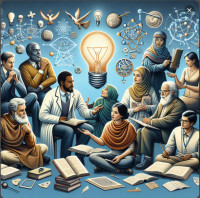
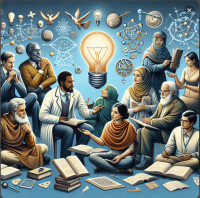
Regarding this notion of a level playing field, I don’t like the
(AI-produced?) picture below. Women sitting at the feet of a man,
looking up to him in admiration. What does this say about a level
playing field?
With love,
Tonnie
*Van:*Tony Budak via OSList <everyone@oslist.org
mailto:everyone@oslist.org>
Verzonden: zondag 26 juli 2026 08:38
Aan: everyone@oslist.org mailto:everyone@oslist.org
Onderwerp: [OSList] Re: 🦋COF On boarding SOP Pilot + First Step
Invitation 🦋
Help People Help Themselves*
Revised Create Our Future outreach***
https://claude.ai/public/artifacts/f1b668e2-2d01-438e-9eae-41ada6468c5b
https://claude.ai/public/artifacts/f1b668e2-2d01-438e-9eae-41ada6468c5b
On 7/21/2026 2:20 AM, Tony Budak via OSList wrote:
 *🦋** COF On boarding SOP Pilot + First Step Invitation **🦋*

 Tony here.

 I’m sharing a test‑ready draft of the Create Our Future on
 boarding SOP for our pilot cohort. It’s built in plainspoken
 language, grounded in Centola’s principles, and shaped so regular
 folks—people who’ve never heard of network science—can follow it
 without friction.

 I’d really value your comments. Anything unclear, too abstract,
 too heavy, or missing a step—tell me. This pilot only works if
 the people we’re inviting can actually use it.

 Second thing: As a COF player, would you be willing to take the
 very first step in forming a COF social cluster? That first step
 is simple: a small group of people choosing to explore something
 they care about together. Nothing formal, nothing big. Just a
 shared purpose and a willingness to try a micro‑practice.

 What about it—are you up for helping us test that first step?

 *Here is the Create Our Future (COF), Participant On boarding
 SOP, Pilot Version 1.0*

   * https://drive.google.com/file/d/1lDWV-dHivVfDsFouq_zFtOAh_cozrDC0/view?usp=sharing
     <https://drive.google.com/file/d/1lDWV-dHivVfDsFouq_zFtOAh_cozrDC0/view?usp=sharing>

 Thanks for taking a look.* Tony*

 Click HERE to Meet with Tony <https://bit.ly/3WtAIgT>

 OSList mailing list --everyone@oslist.org <mailto:everyone@oslist.org>

 To unsubscribe send an email toeveryone-leave@oslist.org <mailto:everyone-leave@oslist.org>

 See the archives here:https://oslist.org/empathy/list/everyone.oslist.org <https://oslist.org/empathy/list/everyone.oslist.org>
--
In Solidarity for more joy, and less stuff,
Tony
Click HERE to Meet with Tony https://bit.ly/3WtAIgT
OSList mailing list --everyone@oslist.org mailto:everyone@oslist.org
To unsubscribe send an email toeveryone-leave@oslist.org mailto:everyone-leave@oslist.org
See the archives here:https://oslist.org/empathy/list/everyone.oslist.org https://oslist.org/empathy/list/everyone.oslist.org
--
In Solidarity for more joy, and less stuff,
Tony
Click HERE to Meet with Tony https://bit.ly/3WtAIgT
--
In Solidarity for more joy, and less stuff,
Tony
Click HERE to Meet with Tony https://bit.ly/3WtAIgT

*Invitation: “Let’s Try a Simple Example Together”*
Peggy, here’s a simple way to see how Centola’s research plays out
inside an Open Space session.
Let’s invite folks to run a tiny, real‑time experiment during the next
OST round. Nothing fancy — just a quick test of how a behavior spreads
once a small circle forms.
Here’s the invitation:
*Challenge:* Join a 20‑minute mini‑session where we test how a
behavior spreads inside an Open Space circle. We’ll start with one
simple action — something harmless and easy, like “share one thing
you learned this week.”

When the group gathers, that circle becomes our temporary “cluster.”
According to Centola’s research, people adopt a new behavior when
they hear the same cue from more than one neighbor. So we’ll watch
what happens as the first person shares, then the second, then the
third.

The question is: *Does the behavior take off once the group gives
each other reinforcement?*

We don’t need pre‑existing relationships. Open Space creates the
network on the spot. The circle itself is the structure that makes
the behavior spread.

After the quick test, we’ll harvest what we saw — what sparked
adoption, what slowed it down, and how this helps us design better
ways for ideas to travel across the whole event.
Outcome: Participants get a hands‑on feel for how Centola’s “clustered
reinforcement” works, even among strangers. And they see how OST
naturally generates the conditions for ideas to spread.
Comments Welcome.
On 8/10/2026 11:35 AM, Tony Budak via OSList wrote:
*_An OST member recently said to me; _*Thanks for the diagram. I’ve
got a question. In my experience, when people show up to Open Space,
they self‑organize beautifully — and most of them don’t know each
other at all. That’s part of the magic. So I’m trying to understand
how the diagram applies inside an Open Space session, where the
connections are being formed on the fly rather than pre‑existing.
Here’s the tension I’m sitting with: Centola’s research shows that
when OST is used as a vehicle for /social behavior change/, it’s
basically throwing snowballs into hell — ineffective, unintentionally
exploitative, and misleading about what’s actually required for norms
to spread. OST is powerful for emergence, creativity, and collective
intelligence. But when it’s asked to carry cultural transformation,
the network science says it simply doesn’t have the structural
reinforcement needed.
A few OST practitioners — myself included — want to see Open Space
applied more widely in social and cultural spaces. But for reasons
nobody quite names, we end up being the risk‑takers pushing it
forward, even though the science tells us the method can’t carry the
load we’re asking of it.
That’s exactly why Create Our Future exists: to rebuild the cultural
structures that make trust, dignity, and shared responsibility
possible again.
This isn’t about inspiration or slogans. It’s about how change
actually spreads.
Centola’s work shows that meaningful cultural change is a complex
contagion. It doesn’t move because one person speaks up. It moves
when people see multiple trusted peers practicing the same behavior
together. That’s why COF starts with clusters — small groups
committed to practicing dignity, reciprocity, and agency. When
clusters /connect/, they form wide bridges, and those bridges
become the pathways for new norms to travel.
If you want to see the science behind this, these three resources lay
out the foundation:
 https://admiredleadership.com/book-summaries/how-behavior-spreads/
 <https://admiredleadership.com/book-summaries/how-behavior-spreads/?utm_source=copilot.com>
 https://admiredleadership.com/book-summaries/change/
 <https://admiredleadership.com/book-summaries/change/?utm_source=copilot.com>
 https://www.learninginnovationslab.org/wp-content/uploads/2021/02/LILA_Winter2021_Centola_02-scaled.jpg
 <https://www.learninginnovationslab.org/wp-content/uploads/2021/02/LILA_Winter2021_Centola_02-scaled.jpg?utm_source=copilot.com>
This is the backbone of Create Our Future’s onboarding: You join a
cluster. Your cluster connects to others. Together, we create the
wide bridges that allow new cultural norms to spread.
I call this a cultural watershed — a place where your commitments,
your mission, and your people can ripple outward in ways that
strengthen both your organization and the communities you serve.
If you’re ready to explore how your work fits into this larger
shift, I’d welcome a conversation.
📖 Choose a time that works for you: Meet with me mobile or on Zoom:
https://pickatime.acuityscheduling.com/
https://pickatime.acuityscheduling.com/?utm_source=copilot.com
Thanks for being here,
Tony
On 8/10/2026 5:05 AM, Tonnie van der Zouwen wrote:
Hi Tony,
Thanks for the diagram. I have a question. In my experience people
participating in Open Space self-otganize, mostly they do not know
each other. So, how does the diagram apply to an Open Space session?
Best,
Tonnie
Dr. Tonnie van der Zouwen MCM
Larikslaan 1
5248 BP Rosmalen
+31 6 50 69 79 82
www.tonnievanderzouwen.nl http://www.tonnievanderzouwen.nl
Van: Tony Budak tonybudak@tbmw.org
Verzonden: Monday, 10 August 2026 08:08:05
Aan: Tonnie van der Zouwen info@tonnievanderzouwen.nl;
everyone@oslist.org everyone@oslist.org
Onderwerp: Re: [OSList] FW: Re: 🦋 COF On boarding SOP Pilot +
First Step Invitation 🦋
Tonnie, here’s a clean, plainspoken visual diagram of clusters and
wide bridges you can use inside Open Space Labs. It’s text‑based so
you can drop it into WhatsApp, Nextdoor, or a slide without fuss.
Visual Diagram — Clusters & Wide Bridges
|[ Cluster A ] ┌────────────────────────────────┐ │ ● ● ● │ │ ● ● ●
(dense ties) │ │ ● ● ● │ └────────────────────────────────┘ ╲ ╱ ╲ ╱ ╲
╱ ╲ ╱ ╳ WIDE BRIDGE (many ties) ╱ ╲ ╱ ╲ ╱ ╲ ╱ ╲
┌────────────────────────────────┐ │ ● ● ● │ │ ● ● ● (dense ties) │ │
● ● ● │ └────────────────────────────────┘ [ Cluster B ] |
What You’re Seeing
*Clusters (left and right boxes)*
Small groups of people who already know each other
Lots of ties inside the group
 Reinforcement happens here (“I see 2–3 people doing it”)


   *Wide Bridge (the X‑shaped middle)*
*Multiple* ties connecting Cluster A to Cluster B
Not one connector, not one champion
 Enough parallel ties for a behavior or norm to /travel/ with
 credibility
Why This Matters for Open Space Labs
*1. Clusters are where new practices take root*
People adopt when they see several neighbors doing the same thing.
*2. Wide bridges let practices travel*
A single tie between groups is too weak. A wide bridge carries
reinforcement across communities.
*3. This is how complex contagions spread*
Hosting, showing up, sharing, experimenting—these are complex
behaviors, not viral memes. They need clusters + wide bridges to move.
Alternate Diagram (more detailed)
|┌───────────────┐ ┌───────────────┐ │ ●─●─● │ ╲ ╱ │ ●─●─● │ │ │ │ │
Cluster │ ╳ │ │ │ │ Cluster │ │ ●─●─● A │ ╱ ╲ │ ●─●─● B │
└───────────────┘ └───────────────┘ Wide Bridge = 4–6 ties connecting
A ↔ B (triads, buddy pairs, shared sessions, rotating groups) |
How to Use This Diagram in Practice
*When launching a new practice*
Start inside a cluster
Build 3–6 ties to the next cluster
 Let norms stabilize before expanding


   *When growing participation*
Reinforce behaviors inside clusters
Connect clusters with wide bridges
Avoid single‑tie “influencer” strategies
Warm Regards,
Tony
On 8/5/2026 3:15 AM, Tonnie van der Zouwen via OSList wrote:
Hi Tony,
A great initiative. I like the summary you made of Centola’s
principles. Also useful for the book I am writing on how to create a
level playing field for collaboration.
Regarding this notion of a level playing field, I don’t like the
(AI-produced?) picture below. Women sitting at the feet of a man,
looking up to him in admiration. What does this say about a level
playing field?
With love,
Tonnie
*Van:*Tony Budak via OSList <everyone@oslist.org
mailto:everyone@oslist.org>
Verzonden: zondag 26 juli 2026 08:38
Aan: everyone@oslist.org mailto:everyone@oslist.org
Onderwerp: [OSList] Re: 🦋COF On boarding SOP Pilot + First Step
Invitation 🦋
Help People Help Themselves*
Revised Create Our Future outreach***
https://claude.ai/public/artifacts/f1b668e2-2d01-438e-9eae-41ada6468c5b
https://claude.ai/public/artifacts/f1b668e2-2d01-438e-9eae-41ada6468c5b
On 7/21/2026 2:20 AM, Tony Budak via OSList wrote:
 *🦋** COF On boarding SOP Pilot + First Step Invitation **🦋*

 Tony here.

 I’m sharing a test‑ready draft of the Create Our Future on
 boarding SOP for our pilot cohort. It’s built in plainspoken
 language, grounded in Centola’s principles, and shaped so
 regular folks—people who’ve never heard of network science—can
 follow it without friction.

 I’d really value your comments. Anything unclear, too abstract,
 too heavy, or missing a step—tell me. This pilot only works if
 the people we’re inviting can actually use it.

 Second thing: As a COF player, would you be willing to take the
 very first step in forming a COF social cluster? That first step
 is simple: a small group of people choosing to explore something
 they care about together. Nothing formal, nothing big. Just a
 shared purpose and a willingness to try a micro‑practice.

 What about it—are you up for helping us test that first step?

 *Here is the Create Our Future (COF), Participant On boarding
 SOP, Pilot Version 1.0*

   * https://drive.google.com/file/d/1lDWV-dHivVfDsFouq_zFtOAh_cozrDC0/view?usp=sharing
     <https://drive.google.com/file/d/1lDWV-dHivVfDsFouq_zFtOAh_cozrDC0/view?usp=sharing>

 Thanks for taking a look.* Tony*

 Click HERE to Meet with Tony <https://bit.ly/3WtAIgT>

 OSList mailing list --everyone@oslist.org <mailto:everyone@oslist.org>

 To unsubscribe send an email toeveryone-leave@oslist.org <mailto:everyone-leave@oslist.org>

 See the archives here:https://oslist.org/empathy/list/everyone.oslist.org <https://oslist.org/empathy/list/everyone.oslist.org>
--
In Solidarity for more joy, and less stuff,
Tony
Click HERE to Meet with Tony https://bit.ly/3WtAIgT
OSList mailing list --everyone@oslist.org mailto:everyone@oslist.org
To unsubscribe send an email toeveryone-leave@oslist.org mailto:everyone-leave@oslist.org
See the archives here:https://oslist.org/empathy/list/everyone.oslist.org https://oslist.org/empathy/list/everyone.oslist.org
--
In Solidarity for more joy, and less stuff,
Tony
Click HERE to Meet with Tony https://bit.ly/3WtAIgT
--
In Solidarity for more joy, and less stuff,
Tony
Click HERE to Meet with Tony https://bit.ly/3WtAIgT
OSList mailing list --everyone@oslist.org
To unsubscribe send an email toeveryone-leave@oslist.org
See the archives here:https://oslist.org/empathy/list/everyone.oslist.org
--
In Solidarity for more joy, and less stuff,
Tony
Click HERE to Meet with Tony https://bit.ly/3WtAIgT


Hi Tony,
My suggestion is that if you want to play with the Centola research in the Open Space Lab, call a session and see who wants to join you.
My bias is that the Centola research provides a nice explanation of dynamics of the hubs and links that form networks. I am a great believer that cultures are slowly migrating from hierarchies to networks as the default form of how humans organize.
I'd be curious to see the research that OST as a vehicle for social behavior change is ineffective. I watched it change lives and culture over the 7 years of Spirited Work and beyond. I haven’t seen formal studies but my empirical evidence is that repeated use of OST changes both individuals and culture.
Peggy
Peggy Holman
peggy@peggyholman.com
Bellevue, WA 98006
206-948-0432
www.peggyholman.com
Enjoy the award winning Engaging Emergence: Turning Upheaval into Opportunity https://peggyholman.com/papers/engaging-emergence/
"An angel told me that the only way to step into the fire and not get burnt, is to become
the fire".
-- Drew Dellinger
On Aug 11, 2026, at 12:47 AM, Tony Budak via OSList everyone@oslist.org wrote:
Invitation: “Let’s Try a Simple Example Together”
Peggy, here’s a simple way to see how Centola’s research plays out inside an Open Space session.
Let’s invite folks to run a tiny, real‑time experiment during the next OST round. Nothing fancy — just a quick test of how a behavior spreads once a small circle forms.
Here’s the invitation:
Challenge: Join a 20‑minute mini‑session where we test how a behavior spreads inside an Open Space circle. We’ll start with one simple action — something harmless and easy, like “share one thing you learned this week.”
When the group gathers, that circle becomes our temporary “cluster.” According to Centola’s research, people adopt a new behavior when they hear the same cue from more than one neighbor. So we’ll watch what happens as the first person shares, then the second, then the third.
The question is: Does the behavior take off once the group gives each other reinforcement?
We don’t need pre‑existing relationships. Open Space creates the network on the spot. The circle itself is the structure that makes the behavior spread.
After the quick test, we’ll harvest what we saw — what sparked adoption, what slowed it down, and how this helps us design better ways for ideas to travel across the whole event.
Outcome: Participants get a hands‑on feel for how Centola’s “clustered reinforcement” works, even among strangers. And they see how OST naturally generates the conditions for ideas to spread.
Comments Welcome.
On 8/10/2026 11:35 AM, Tony Budak via OSList wrote:
An OST member recently said to me; Thanks for the diagram. I’ve got a question. In my experience, when people show up to Open Space, they self‑organize beautifully — and most of them don’t know each other at all. That’s part of the magic. So I’m trying to understand how the diagram applies inside an Open Space session, where the connections are being formed on the fly rather than pre‑existing.
Here’s the tension I’m sitting with: Centola’s research shows that when OST is used as a vehicle for social behavior change, it’s basically throwing snowballs into hell — ineffective, unintentionally exploitative, and misleading about what’s actually required for norms to spread. OST is powerful for emergence, creativity, and collective intelligence. But when it’s asked to carry cultural transformation, the network science says it simply doesn’t have the structural reinforcement needed.
A few OST practitioners — myself included — want to see Open Space applied more widely in social and cultural spaces. But for reasons nobody quite names, we end up being the risk‑takers pushing it forward, even though the science tells us the method can’t carry the load we’re asking of it.
That’s exactly why Create Our Future exists: to rebuild the cultural structures that make trust, dignity, and shared responsibility possible again.
This isn’t about inspiration or slogans. It’s about how change actually spreads.
Centola’s work shows that meaningful cultural change is a complex contagion. It doesn’t move because one person speaks up. It moves when people see multiple trusted peers practicing the same behavior together. That’s why COF starts with clusters — small groups committed to practicing dignity, reciprocity, and agency. When clusters connect, they form wide bridges, and those bridges become the pathways for new norms to travel.
If you want to see the science behind this, these three resources lay out the foundation:
https://admiredleadership.com/book-summaries/how-behavior-spreads/ https://admiredleadership.com/book-summaries/how-behavior-spreads/?utm_source=copilot.com
https://admiredleadership.com/book-summaries/change/ https://admiredleadership.com/book-summaries/change/?utm_source=copilot.com
https://www.learninginnovationslab.org/wp-content/uploads/2021/02/LILA_Winter2021_Centola_02-scaled.jpg https://www.learninginnovationslab.org/wp-content/uploads/2021/02/LILA_Winter2021_Centola_02-scaled.jpg?utm_source=copilot.com
This is the backbone of Create Our Future’s onboarding: You join a cluster. Your cluster connects to others. Together, we create the wide bridges that allow new cultural norms to spread.
I call this a cultural watershed — a place where your commitments, your mission, and your people can ripple outward in ways that strengthen both your organization and the communities you serve.
If you’re ready to explore how your work fits into this larger shift, I’d welcome a conversation.
📖 Choose a time that works for you: Meet with me mobile or on Zoom: https://pickatime.acuityscheduling.com/ https://pickatime.acuityscheduling.com/?utm_source=copilot.comThanks for being here,
Tony
On 8/10/2026 5:05 AM, Tonnie van der Zouwen wrote:
Hi Tony,
Thanks for the diagram. I have a question. In my experience people participating in Open Space self-otganize, mostly they do not know each other. So, how does the diagram apply to an Open Space session?
Best,
Tonnie
Dr. Tonnie van der Zouwen MCM
Larikslaan 1
5248 BP Rosmalen
+31 6 50 69 79 82
www.tonnievanderzouwen.nl http://www.tonnievanderzouwen.nl/
Van: Tony Budak tonybudak@tbmw.org mailto:tonybudak@tbmw.org
Verzonden: Monday, 10 August 2026 08:08:05
Aan: Tonnie van der Zouwen info@tonnievanderzouwen.nl mailto:info@tonnievanderzouwen.nl; everyone@oslist.org mailto:everyone@oslist.org everyone@oslist.org mailto:everyone@oslist.org
Onderwerp: Re: [OSList] FW: Re: 🦋 COF On boarding SOP Pilot + First Step Invitation 🦋
Tonnie, here’s a clean, plainspoken visual diagram of clusters and wide bridges you can use inside Open Space Labs. It’s text‑based so you can drop it into WhatsApp, Nextdoor, or a slide without fuss.
Visual Diagram — Clusters & Wide Bridges
                [ Cluster A ]
     ┌────────────────────────────────┐
     │  ●  ●  ●                       │
     │  ●  ●  ●   (dense ties)        │
     │  ●  ●  ●                       │
     └────────────────────────────────┘
              ╲   ╱   ╲   ╱
               ╲ ╱     ╲ ╱
                ╳  WIDE BRIDGE (many ties)
               ╱ ╲     ╱ ╲
              ╱   ╲   ╱   ╲
     ┌────────────────────────────────┐
     │  ●  ●  ●                       │
     │  ●  ●  ●   (dense ties)        │
     │  ●  ●  ●                       │
     └────────────────────────────────┘
                [ Cluster B ]
What You’re Seeing
Clusters (left and right boxes)
Small groups of people who already know each other
Lots of ties inside the group
Reinforcement happens here (“I see 2–3 people doing it”)
Wide Bridge (the X‑shaped middle)
Multiple ties connecting Cluster A to Cluster B
Not one connector, not one champion
Enough parallel ties for a behavior or norm to travel with credibility
Why This Matters for Open Space Labs
- Clusters are where new practices take root
People adopt when they see several neighbors doing the same thing.
- Wide bridges let practices travel
A single tie between groups is too weak. A wide bridge carries reinforcement across communities.
- This is how complex contagions spread
Hosting, showing up, sharing, experimenting—these are complex behaviors, not viral memes. They need clusters + wide bridges to move.
Alternate Diagram (more detailed)
      ┌───────────────┐          ┌───────────────┐
      │  ●─●─●         │   ╲ ╱    │  ●─●─●         │
      │  │ │ │ Cluster │    ╳     │  │ │ │ Cluster │
      │  ●─●─●    A    │   ╱ ╲    │  ●─●─●    B    │
      └───────────────┘          └───────────────┘

Wide Bridge = 4–6 ties connecting A ↔ B
(triads, buddy pairs, shared sessions, rotating groups)
How to Use This Diagram in Practice
When launching a new practice
Start inside a cluster
Build 3–6 ties to the next cluster
Let norms stabilize before expanding
When growing participation
Reinforce behaviors inside clusters
Connect clusters with wide bridges
Avoid single‑tie “influencer” strategies
Warm Regards,
Tony
On 8/5/2026 3:15 AM, Tonnie van der Zouwen via OSList wrote:
Hi Tony,
A great initiative. I like the summary you made of Centola’s principles. Also useful for the book I am writing on how to create a level playing field for collaboration.
Regarding this notion of a level playing field, I don’t like the (AI-produced?) picture below. Women sitting at the feet of a man, looking up to him in admiration. What does this say about a level playing field?
With love,
Tonnie
<image002.png>
Van: Tony Budak via OSList <everyone@oslist.org mailto:everyone@oslist.org>
Verzonden: zondag 26 juli 2026 08:38
Aan: everyone@oslist.org mailto:everyone@oslist.org
Onderwerp: [OSList] Re: 🦋 COF On boarding SOP Pilot + First Step Invitation 🦋
<image001.jpg>
Revised Create Our Future outreach
https://claude.ai/public/artifacts/f1b668e2-2d01-438e-9eae-41ada6468c5b
On 7/21/2026 2:20 AM, Tony Budak via OSList wrote:
🦋 COF On boarding SOP Pilot + First Step Invitation 🦋
Tony here.
I’m sharing a test‑ready draft of the Create Our Future on boarding SOP for our pilot cohort. It’s built in plainspoken language, grounded in Centola’s principles, and shaped so regular folks—people who’ve never heard of network science—can follow it without friction.
I’d really value your comments. Anything unclear, too abstract, too heavy, or missing a step—tell me. This pilot only works if the people we’re inviting can actually use it.
Second thing: As a COF player, would you be willing to take the very first step in forming a COF social cluster? That first step is simple: a small group of people choosing to explore something they care about together. Nothing formal, nothing big. Just a shared purpose and a willingness to try a micro‑practice.
What about it—are you up for helping us test that first step?
Here is the Create Our Future (COF), Participant On boarding SOP, Pilot Version 1.0
https://drive.google.com/file/d/1lDWV-dHivVfDsFouq_zFtOAh_cozrDC0/view?usp=sharing
Thanks for taking a look. Tony
Click HERE to Meet with Tony https://bit.ly/3WtAIgT
OSList mailing list -- everyone@oslist.org mailto:everyone@oslist.org
To unsubscribe send an email to everyone-leave@oslist.org mailto:everyone-leave@oslist.org
See the archives here: https://oslist.org/empathy/list/everyone.oslist.org
In Solidarity for more joy, and less stuff,
Tony
Click HERE to Meet with Tony https://bit.ly/3WtAIgT
OSList mailing list -- everyone@oslist.org mailto:everyone@oslist.org
To unsubscribe send an email to everyone-leave@oslist.org mailto:everyone-leave@oslist.org
See the archives here: https://oslist.org/empathy/list/everyone.oslist.org
--
In Solidarity for more joy, and less stuff,
Tony
Click HERE to Meet with Tony https://bit.ly/3WtAIgT--
In Solidarity for more joy, and less stuff,
Tony
Click HERE to Meet with Tony https://bit.ly/3WtAIgT
OSList mailing list -- everyone@oslist.org mailto:everyone@oslist.org
To unsubscribe send an email to everyone-leave@oslist.org mailto:everyone-leave@oslist.org
See the archives here: https://oslist.org/empathy/list/everyone.oslist.org
--
In Solidarity for more joy, and less stuff,
Tony
Click HERE to Meet with Tony https://bit.ly/3WtAIgTOSList mailing list -- everyone@oslist.org mailto:everyone@oslist.org
To unsubscribe send an email to everyone-leave@oslist.org mailto:everyone-leave@oslist.org
See the archives here: https://oslist.org/empathy/list/everyone.oslist.org
Peggy, thanks for this — I appreciate the invitation to call a session.
I’ll do that. I think a handful of folks would enjoy playing with
Centola’s work inside an OST frame and seeing what shows up.
And I want to name something clearly, because I respect your experience
with Spirited Work. I’m not questioning whether OST can change people.
I’ve watched it do that too. When people gather repeatedly in a
container that honors dignity, choice, and responsibility, they grow. No
argument there.
The distinction I’m pointing to is narrower: *Centola’s research isn’t
about personal transformation — it’s about how */new behaviors and
norms/spread across a wider network. That’s where the science says
OST doesn’t provide the reinforcement structure needed for a behavior to
travel beyond the room. OST creates powerful experiences, but it doesn’t
create the “wide bridges” that allow a new norm to propagate through a
community.
That’s the part I’m exploring.
So here’s what I’d love to test in the Lab: A simple, real‑time
experiment where we watch how a behavior spreads inside an OST circle,
and then look at what happens /after/ the circle dissolves. Does the
behavior continue? Does it jump to other groups? Or does it stay inside
the session?
Your experience with Spirited Work is invaluable here. You saw long‑term
cultural effects, and I want to understand those stories more deeply.
They may point to conditions that allowed reinforcement to happen
outside the sessions — which is exactly the kind of thing Centola says
makes the difference.
I’ll post a session invitation shortly so folks can join the experiment.
Thanks for your time, and wisdom, thanks again,
Tony
On 8/11/2026 11:55 AM, Peggy Holman via OSList wrote:
Hi Tony,
My suggestion is that if you want to play with the Centola research in
the Open Space Lab, call a session and see who wants to join you.
My bias is that the Centola research provides a nice explanation of
dynamics of the hubs and links that form networks. I am a great
believer that cultures are slowly migrating from hierarchies to
networks as the default form of how humans organize.
I'd be curious to see the research that OST as a vehicle for social
behavior change is ineffective. I watched it change lives and culture
over the 7 years of Spirited Work and beyond. I haven’t seen formal
studies but my empirical evidence is that repeated use of OST changes
both individuals and culture.
Peggy
Peggy Holman
peggy@peggyholman.com
Bellevue, WA 98006
206-948-0432
www.peggyholman.com
Enjoy the award winning Engaging Emergence: Turning Upheaval
into Opportunity https://peggyholman.com/papers/engaging-emergence/
"An angel told me that the only way to step into the fire and not get
burnt, is to become
the fire".
-- Drew Dellinger
On Aug 11, 2026, at 12:47 AM, Tony Budak via OSList
everyone@oslist.org wrote:
*Invitation: “Let’s Try a Simple Example Together”*
Peggy, here’s a simple way to see how Centola’s research plays out
inside an Open Space session.
Let’s invite folks to run a tiny, real‑time experiment during the
next OST round. Nothing fancy — just a quick test of how a behavior
spreads once a small circle forms.
Here’s the invitation:
 *Challenge:* Join a 20‑minute mini‑session where we test how a
 behavior spreads inside an Open Space circle. We’ll start with
 one simple action — something harmless and easy, like “share one
 thing you learned this week.”

 When the group gathers, that circle becomes our temporary
 “cluster.” According to Centola’s research, people adopt a new
 behavior when they hear the same cue from more than one neighbor.
 So we’ll watch what happens as the first person shares, then the
 second, then the third.

 The question is: *Does the behavior take off once the group gives
 each other reinforcement?*

 We don’t need pre‑existing relationships. Open Space creates the
 network on the spot. The circle itself is the structure that
 makes the behavior spread.

 After the quick test, we’ll harvest what we saw — what sparked
 adoption, what slowed it down, and how this helps us design
 better ways for ideas to travel across the whole event.
Outcome: Participants get a hands‑on feel for how Centola’s
“clustered reinforcement” works, even among strangers. And they see
how OST naturally generates the conditions for ideas to spread.
Comments Welcome.
On 8/10/2026 11:35 AM, Tony Budak via OSList wrote:
*An OST member recently said to me;*Thanks for the diagram. I’ve
got a question. In my experience, when people show up to Open Space,
they self‑organize beautifully — and most of them don’t know each
other at all. That’s part of the magic. So I’m trying to understand
how the diagram applies inside an Open Space session, where the
connections are being formed on the fly rather than pre‑existing.
Here’s the tension I’m sitting with: Centola’s research shows that
when OST is used as a vehicle for/social behavior change/, it’s
basically throwing snowballs into hell — ineffective,
unintentionally exploitative, and misleading about what’s actually
required for norms to spread. OST is powerful for emergence,
creativity, and collective intelligence. But when it’s asked to
carry cultural transformation, the network science says it simply
doesn’t have the structural reinforcement needed.
A few OST practitioners — myself included — want to see Open Space
applied more widely in social and cultural spaces. But for reasons
nobody quite names, we end up being the risk‑takers pushing it
forward, even though the science tells us the method can’t carry the
load we’re asking of it.
That’s exactly why Create Our Future exists:to rebuild the cultural
structures that make trust, dignity, and shared responsibility
possible again.
This isn’t about inspiration or slogans. It’s about how change
actually spreads.
Centola’s work shows that meaningful cultural change is acomplex
contagion. It doesn’t move because one person speaks up. It moves
when people seemultiple trusted peerspracticing the same behavior
together. That’s why COF starts withclusters— small groups
committed to practicing dignity, reciprocity, and agency. When
clusters/connect/, they formwide bridges, and those bridges
become the pathways for new norms to travel.
If you want to see the science behind this, these three resources
lay out the foundation:
 https://admiredleadership.com/book-summaries/how-behavior-spreads/
 <https://admiredleadership.com/book-summaries/how-behavior-spreads/?utm_source=copilot.com>
 https://admiredleadership.com/book-summaries/change/
 <https://admiredleadership.com/book-summaries/change/?utm_source=copilot.com>
 https://www.learninginnovationslab.org/wp-content/uploads/2021/02/LILA_Winter2021_Centola_02-scaled.jpg
 <https://www.learninginnovationslab.org/wp-content/uploads/2021/02/LILA_Winter2021_Centola_02-scaled.jpg?utm_source=copilot.com>
This is the backbone of Create Our Future’s onboarding:*You join a
cluster.**Your cluster connects to others.*Together, we create the
wide bridges that allow new cultural norms to spread.
I call this acultural watershed— a place where your commitments,
your mission, and your people can ripple outward in ways that
strengthen both your organization and the communities you serve.
If you’re ready to explore how your work fits into this larger
shift, I’d welcome a conversation.
📖*Choose a time that works for you:*Meet with me mobile or on
Zoom:https://pickatime.acuityscheduling.com/
https://pickatime.acuityscheduling.com/?utm_source=copilot.com
Thanks for being here,
Tony
On 8/10/2026 5:05 AM, Tonnie van der Zouwen wrote:
Hi Tony,
Thanks for the diagram. I have a question. In my experience people
participating in Open Space self-otganize, mostly they do not know
each other. So, how does the diagram apply to an Open Space session?
Best,
Tonnie
Dr. Tonnie van der Zouwen MCM
Larikslaan 1
5248 BP Rosmalen
+31 6 50 69 79 82
www.tonnievanderzouwen.nl http://www.tonnievanderzouwen.nl/
*Van:*Tony Budaktonybudak@tbmw.org
*Verzonden:*Monday, 10 August 2026 08:08:05
*Aan:*Tonnie van der
Zouweninfo@tonnievanderzouwen.nl;everyone@oslist.orgeveryone@oslist.org
*Onderwerp:*Re: [OSList] FW: Re: 🦋 COF On boarding SOP Pilot +
First Step Invitation 🦋
Tonnie, here’s aclean, plainspoken visual diagramofclusters and
wide bridgesyou can use inside Open Space Labs. It’s text‑based so
you can drop it into WhatsApp, Nextdoor, or a slide without fuss.
Visual Diagram — Clusters & Wide Bridges
|[ Cluster A ] ┌────────────────────────────────┐ │ ● ● ● │ │ ● ● ●
(dense ties) │ │ ● ● ● │ └────────────────────────────────┘ ╲ ╱ ╲ ╱
╲ ╱ ╲ ╱ ╳ WIDE BRIDGE (many ties) ╱ ╲ ╱ ╲ ╱ ╲ ╱ ╲
┌────────────────────────────────┐ │ ● ● ● │ │ ● ● ● (dense ties) │
│ ● ● ● │ └────────────────────────────────┘ [ Cluster B ] |
What You’re Seeing
*Clusters (left and right boxes)*
Small groups of people who already know each other
Lots of ties inside the group
 Reinforcement happens here (“I see 2–3 people doing it”)


   *Wide Bridge (the X‑shaped middle)*
*Multiple*ties connecting Cluster A to Cluster B
Not one connector, not one champion
 Enough parallel ties for a behavior or norm to/travel/with
 credibility
Why This Matters for Open Space Labs
*1. Clusters are where new practices take root*
People adopt when they seeseveral neighborsdoing the same thing.
*2. Wide bridges let practices travel*
A single tie between groups is too weak. A wide bridge
carriesreinforcement across communities.
*3. This is how complex contagions spread*
Hosting, showing up, sharing, experimenting—these arecomplex
behaviors, not viral memes. They needclusters + wide bridgesto move.
Alternate Diagram (more detailed)
|┌───────────────┐ ┌───────────────┐ │ ●─●─● │ ╲ ╱ │ ●─●─● │ │ │ │
│ Cluster │ ╳ │ │ │ │ Cluster │ │ ●─●─● A │ ╱ ╲ │ ●─●─● B │
└───────────────┘ └───────────────┘ Wide Bridge = 4–6 ties
connecting A ↔ B (triads, buddy pairs, shared sessions, rotating
groups) |
How to Use This Diagram in Practice
*When launching a new practice*
Start inside a cluster
Build 3–6 ties to the next cluster
 Let norms stabilize before expanding


   *When growing participation*
Reinforce behaviors inside clusters
Connect clusters with wide bridges
Avoid single‑tie “influencer” strategies
Warm Regards,
Tony
On 8/5/2026 3:15 AM, Tonnie van der Zouwen via OSList wrote:
Hi Tony,
A great initiative. I like the summary you made of Centola’s
principles. Also useful for the book I am writing on how to create
a level playing field for collaboration.
Regarding this notion of a level playing field, I don’t like the
(AI-produced?) picture below. Women sitting at the feet of a man,
looking up to him in admiration. What does this say about a level
playing field?
With love,
Tonnie
<image002.png>
*Van:*Tony Budak via OSList <everyone@oslist.org
mailto:everyone@oslist.org>
*Verzonden:*zondag 26 juli 2026 08:38
*Aan:*everyone@oslist.org mailto:everyone@oslist.org
Onderwerp:[OSList] Re:🦋COF On boarding SOP Pilot + First Step
Invitation🦋
<image001.jpg>*
Revised Create Our Future outreach***
https://claude.ai/public/artifacts/f1b668e2-2d01-438e-9eae-41ada6468c5b
https://claude.ai/public/artifacts/f1b668e2-2d01-438e-9eae-41ada6468c5b
On 7/21/2026 2:20 AM, Tony Budak via OSList wrote:
 *🦋** COF On boarding SOP Pilot + First Step Invitation**🦋*

 Tony here.

 I’m sharing a test‑ready draft of the Create Our Future on
 boarding SOP for our pilot cohort. It’s built in plainspoken
 language, grounded in Centola’s principles, and shaped so
 regular folks—people who’ve never heard of network science—can
 follow it without friction.

 I’d really value your comments. Anything unclear, too
 abstract, too heavy, or missing a step—tell me. This pilot
 only works if the people we’re inviting can actually use it.

 Second thing: As a COF player, would you be willing to take
 the very first step in forming a COF social cluster? That
 first step is simple: a small group of people choosing to
 explore something they care about together. Nothing formal,
 nothing big. Just a shared purpose and a willingness to try a
 micro‑practice.

 What about it—are you up for helping us test that first step?

 *Here is the Create Our Future (COF), Participant On boarding
 SOP, Pilot Version 1.0*

   * https://drive.google.com/file/d/1lDWV-dHivVfDsFouq_zFtOAh_cozrDC0/view?usp=sharing
     <https://drive.google.com/file/d/1lDWV-dHivVfDsFouq_zFtOAh_cozrDC0/view?usp=sharing>

 Thanks for taking a look.* Tony*

 Click HERE to Meet with Tony <https://bit.ly/3WtAIgT>


 OSList mailing list --everyone@oslist.org <mailto:everyone@oslist.org>

 To unsubscribe send an email toeveryone-leave@oslist.org <mailto:everyone-leave@oslist.org>

 See the archives here:https://oslist.org/empathy/list/everyone.oslist.org <https://oslist.org/empathy/list/everyone.oslist.org>
--
In Solidarity for more joy, and less stuff,
Tony
Click HERE to Meet with Tony https://bit.ly/3WtAIgT
OSList mailing list --everyone@oslist.org mailto:everyone@oslist.org
To unsubscribe send an email toeveryone-leave@oslist.org mailto:everyone-leave@oslist.org
See the archives here:https://oslist.org/empathy/list/everyone.oslist.org https://oslist.org/empathy/list/everyone.oslist.org
--
In Solidarity for more joy, and less stuff,
Tony
Click HERE to Meet with Tony https://bit.ly/3WtAIgT
--
In Solidarity for more joy, and less stuff,
Tony
Click HERE to Meet with Tony https://bit.ly/3WtAIgT
OSList mailing list --everyone@oslist.org
To unsubscribe send an email toeveryone-leave@oslist.org
See the archives here:https://oslist.org/empathy/list/everyone.oslist.org
--
In Solidarity for more joy, and less stuff,
Tony
Click HERE to Meet with Tony https://bit.ly/3WtAIgT
OSList mailing list --everyone@oslist.org
To unsubscribe send an email toeveryone-leave@oslist.org
See the archives here:https://oslist.org/empathy/list/everyone.oslist.org
OSList mailing list --everyone@oslist.org
To unsubscribe send an email toeveryone-leave@oslist.org
See the archives here:https://oslist.org/empathy/list/everyone.oslist.org
--
In Solidarity for more joy, and less stuff,
Tony
Click HERE to Meet with Tony https://bit.ly/3WtAIgT

Dear friends in open space
I know that ‘Open Space Technology’ can look very different depending on many factors. So I think it is impossible to say what impact OST has in general.
I have used OST many hundred times the past almost 30 years I have been working with organisational development and almost always used OST as part of the process.
When I teach and work with Open Space Technology, it’s not only a meeting. It’s a holistic process, including a preparatory face to clarify and create the best possible conditions for sustainable results.
The OST includes divergence where issues and opportunities are explored as well as convergence where priorities are made including action plans and teams taking responsibility for moving issues forward.
I always include a follow-up meeting within two weeks as well as a impact evaluation and planning next steps after about six months. Sometimes we train conveners of action plans to build skills to work co-creatively (Basics of Whole Persson Process Facilitation, WPPF) with their teams coming out of the OST session.
I use question from Kirkpatrick four levels to get an idea of impacts. It’s quite amazing what impacts we see both regarding cultural change as well as improve business.
In my facilitation, I use WPPF in all meetings but the OST meetings. I’ve learnt a lot from Birgitt WiIliams and the Genuine Contact Way of working, which makes a huge difference in my opinion and experience.
Thanks for questioning and looking at more possibilities to make a difference in the world, Tony.
All the best,
Thomas Herrmann
Skickat från Outlook för iOShttps://aka.ms/o0ukef
Från: Tony Budak via OSList everyone@oslist.org
Skickat: Tuesday, 11 August 2026 22:05:09
Till: peggy@peggyholman.com peggy@peggyholman.com; everyone@oslist.org everyone@oslist.org
Ämne: [OSList] Re: 🦋 COF On boarding SOP Pilot + First Step Invitation 🦋
Peggy, thanks for this — I appreciate the invitation to call a session. I’ll do that. I think a handful of folks would enjoy playing with Centola’s work inside an OST frame and seeing what shows up.
And I want to name something clearly, because I respect your experience with Spirited Work. I’m not questioning whether OST can change people. I’ve watched it do that too. When people gather repeatedly in a container that honors dignity, choice, and responsibility, they grow. No argument there.
The distinction I’m pointing to is narrower: Centola’s research isn’t about personal transformation — it’s about how new behaviors and norms spread across a wider network. That’s where the science says OST doesn’t provide the reinforcement structure needed for a behavior to travel beyond the room. OST creates powerful experiences, but it doesn’t create the “wide bridges” that allow a new norm to propagate through a community.
That’s the part I’m exploring.
So here’s what I’d love to test in the Lab: A simple, real‑time experiment where we watch how a behavior spreads inside an OST circle, and then look at what happens after the circle dissolves. Does the behavior continue? Does it jump to other groups? Or does it stay inside the session?
Your experience with Spirited Work is invaluable here. You saw long‑term cultural effects, and I want to understand those stories more deeply. They may point to conditions that allowed reinforcement to happen outside the sessions — which is exactly the kind of thing Centola says makes the difference.
I’ll post a session invitation shortly so folks can join the experiment.
Thanks for your time, and wisdom, thanks again,
Tony
On 8/11/2026 11:55 AM, Peggy Holman via OSList wrote:
Hi Tony,
My suggestion is that if you want to play with the Centola research in the Open Space Lab, call a session and see who wants to join you.
My bias is that the Centola research provides a nice explanation of dynamics of the hubs and links that form networks. I am a great believer that cultures are slowly migrating from hierarchies to networks as the default form of how humans organize.
I'd be curious to see the research that OST as a vehicle for social behavior change is ineffective. I watched it change lives and culture over the 7 years of Spirited Work and beyond. I haven’t seen formal studies but my empirical evidence is that repeated use of OST changes both individuals and culture.
Peggy
Peggy Holman
peggy@peggyholman.commailto:peggy@peggyholman.com
Bellevue, WA 98006
206-948-0432
www.peggyholman.comhttp://www.peggyholman.com
Enjoy the award winning Engaging Emergence: Turning Upheaval into Opportunityhttps://peggyholman.com/papers/engaging-emergence/
"An angel told me that the only way to step into the fire and not get burnt, is to become
the fire".
-- Drew Dellinger
On Aug 11, 2026, at 12:47 AM, Tony Budak via OSList everyone@oslist.orgmailto:everyone@oslist.org wrote:
Invitation: “Let’s Try a Simple Example Together”
Peggy, here’s a simple way to see how Centola’s research plays out inside an Open Space session.
Let’s invite folks to run a tiny, real‑time experiment during the next OST round. Nothing fancy — just a quick test of how a behavior spreads once a small circle forms.
Here’s the invitation:
Challenge: Join a 20‑minute mini‑session where we test how a behavior spreads inside an Open Space circle. We’ll start with one simple action — something harmless and easy, like “share one thing you learned this week.”
When the group gathers, that circle becomes our temporary “cluster.” According to Centola’s research, people adopt a new behavior when they hear the same cue from more than one neighbor. So we’ll watch what happens as the first person shares, then the second, then the third.
The question is: Does the behavior take off once the group gives each other reinforcement?
We don’t need pre‑existing relationships. Open Space creates the network on the spot. The circle itself is the structure that makes the behavior spread.
After the quick test, we’ll harvest what we saw — what sparked adoption, what slowed it down, and how this helps us design better ways for ideas to travel across the whole event.
Outcome: Participants get a hands‑on feel for how Centola’s “clustered reinforcement” works, even among strangers. And they see how OST naturally generates the conditions for ideas to spread.
Comments Welcome.
On 8/10/2026 11:35 AM, Tony Budak via OSList wrote:
An OST member recently said to me; Thanks for the diagram. I’ve got a question. In my experience, when people show up to Open Space, they self‑organize beautifully — and most of them don’t know each other at all. That’s part of the magic. So I’m trying to understand how the diagram applies inside an Open Space session, where the connections are being formed on the fly rather than pre‑existing.
Here’s the tension I’m sitting with: Centola’s research shows that when OST is used as a vehicle for social behavior change, it’s basically throwing snowballs into hell — ineffective, unintentionally exploitative, and misleading about what’s actually required for norms to spread. OST is powerful for emergence, creativity, and collective intelligence. But when it’s asked to carry cultural transformation, the network science says it simply doesn’t have the structural reinforcement needed.
A few OST practitioners — myself included — want to see Open Space applied more widely in social and cultural spaces. But for reasons nobody quite names, we end up being the risk‑takers pushing it forward, even though the science tells us the method can’t carry the load we’re asking of it.
That’s exactly why Create Our Future exists: to rebuild the cultural structures that make trust, dignity, and shared responsibility possible again.
This isn’t about inspiration or slogans. It’s about how change actually spreads.
Centola’s work shows that meaningful cultural change is a complex contagion. It doesn’t move because one person speaks up. It moves when people see multiple trusted peers practicing the same behavior together. That’s why COF starts with clusters — small groups committed to practicing dignity, reciprocity, and agency. When clusters connect, they form wide bridges, and those bridges become the pathways for new norms to travel.
If you want to see the science behind this, these three resources lay out the foundation:
-
https://admiredleadership.com/book-summaries/how-behavior-spreads/https://admiredleadership.com/book-summaries/how-behavior-spreads/?utm_source=copilot.com
-
https://admiredleadership.com/book-summaries/change/https://admiredleadership.com/book-summaries/change/?utm_source=copilot.com
-
https://www.learninginnovationslab.org/wp-content/uploads/2021/02/LILA_Winter2021_Centola_02-scaled.jpghttps://www.learninginnovationslab.org/wp-content/uploads/2021/02/LILA_Winter2021_Centola_02-scaled.jpg?utm_source=copilot.com
This is the backbone of Create Our Future’s onboarding: You join a cluster. Your cluster connects to others. Together, we create the wide bridges that allow new cultural norms to spread.
I call this a cultural watershed — a place where your commitments, your mission, and your people can ripple outward in ways that strengthen both your organization and the communities you serve.
If you’re ready to explore how your work fits into this larger shift, I’d welcome a conversation.
📖 Choose a time that works for you: Meet with me mobile or on Zoom: https://pickatime.acuityscheduling.com/https://pickatime.acuityscheduling.com/?utm_source=copilot.com
Thanks for being here,
Tony
On 8/10/2026 5:05 AM, Tonnie van der Zouwen wrote:
Hi Tony,
Thanks for the diagram. I have a question. In my experience people participating in Open Space self-otganize, mostly they do not know each other. So, how does the diagram apply to an Open Space session?
Best,
Tonnie
Dr. Tonnie van der Zouwen MCM
Larikslaan 1
5248 BP Rosmalen
+31 6 50 69 79 82
www.tonnievanderzouwen.nlhttp://www.tonnievanderzouwen.nl/
Van: Tony Budak tonybudak@tbmw.orgmailto:tonybudak@tbmw.org
Verzonden: Monday, 10 August 2026 08:08:05
Aan: Tonnie van der Zouwen info@tonnievanderzouwen.nlmailto:info@tonnievanderzouwen.nl; everyone@oslist.orgmailto:everyone@oslist.org everyone@oslist.orgmailto:everyone@oslist.org
Onderwerp: Re: [OSList] FW: Re: 🦋 COF On boarding SOP Pilot + First Step Invitation 🦋
Tonnie, here’s a clean, plainspoken visual diagram of clusters and wide bridges you can use inside Open Space Labs. It’s text‑based so you can drop it into WhatsApp, Nextdoor, or a slide without fuss.
Visual Diagram — Clusters & Wide Bridges
               [ Cluster A ]
    ┌────────────────────────────────┐
    │  ●  ●  ●                       │
    │  ●  ●  ●   (dense ties)        │
    │  ●  ●  ●                       │
    └────────────────────────────────┘
             ╲   ╱   ╲   ╱
              ╲ ╱     ╲ ╱
               ╳  WIDE BRIDGE (many ties)
              ╱ ╲     ╱ ╲
             ╱   ╲   ╱   ╲
    ┌────────────────────────────────┐
    │  ●  ●  ●                       │
    │  ●  ●  ●   (dense ties)        │
    │  ●  ●  ●                       │
    └────────────────────────────────┘
               [ Cluster B ]
What You’re Seeing
Clusters (left and right boxes)
-
Small groups of people who already know each other
-
Lots of ties inside the group
-
Reinforcement happens here (“I see 2–3 people doing it”)
Wide Bridge (the X‑shaped middle)
-
Multiple ties connecting Cluster A to Cluster B
-
Not one connector, not one champion
-
Enough parallel ties for a behavior or norm to travel with credibility
Why This Matters for Open Space Labs
- Clusters are where new practices take root
People adopt when they see several neighbors doing the same thing.
- Wide bridges let practices travel
A single tie between groups is too weak. A wide bridge carries reinforcement across communities.
- This is how complex contagions spread
Hosting, showing up, sharing, experimenting—these are complex behaviors, not viral memes. They need clusters + wide bridges to move.
Alternate Diagram (more detailed)
     ┌───────────────┐          ┌───────────────┐
     │  ●─●─●         │   ╲ ╱    │  ●─●─●         │
     │  │ │ │ Cluster │    ╳     │  │ │ │ Cluster │
     │  ●─●─●    A    │   ╱ ╲    │  ●─●─●    B    │
     └───────────────┘          └───────────────┘
Wide Bridge = 4–6 ties connecting A ↔ B
(triads, buddy pairs, shared sessions, rotating groups)
How to Use This Diagram in Practice
When launching a new practice
-
Start inside a cluster
-
Build 3–6 ties to the next cluster
-
Let norms stabilize before expanding
When growing participation
-
Reinforce behaviors inside clusters
-
Connect clusters with wide bridges
-
Avoid single‑tie “influencer” strategies
Warm Regards,
Tony
On 8/5/2026 3:15 AM, Tonnie van der Zouwen via OSList wrote:
Hi Tony,
A great initiative. I like the summary you made of Centola’s principles. Also useful for the book I am writing on how to create a level playing field for collaboration.
Regarding this notion of a level playing field, I don’t like the (AI-produced?) picture below. Women sitting at the feet of a man, looking up to him in admiration. What does this say about a level playing field?
With love,
Tonnie
<image002.png>
Van: Tony Budak via OSList <everyone@oslist.orgmailto:everyone@oslist.org>
Verzonden: zondag 26 juli 2026 08:38
Aan: everyone@oslist.orgmailto:everyone@oslist.org
Onderwerp: [OSList] Re: 🦋 COF On boarding SOP Pilot + First Step Invitation 🦋
<image001.jpg>
Revised Create Our Future outreach
https://claude.ai/public/artifacts/f1b668e2-2d01-438e-9eae-41ada6468c5b
On 7/21/2026 2:20 AM, Tony Budak via OSList wrote:
🦋 COF On boarding SOP Pilot + First Step Invitation 🦋
Tony here.
I’m sharing a test‑ready draft of the Create Our Future on boarding SOP for our pilot cohort. It’s built in plainspoken language, grounded in Centola’s principles, and shaped so regular folks—people who’ve never heard of network science—can follow it without friction.
I’d really value your comments. Anything unclear, too abstract, too heavy, or missing a step—tell me. This pilot only works if the people we’re inviting can actually use it.
Second thing: As a COF player, would you be willing to take the very first step in forming a COF social cluster? That first step is simple: a small group of people choosing to explore something they care about together. Nothing formal, nothing big. Just a shared purpose and a willingness to try a micro‑practice.
What about it—are you up for helping us test that first step?
Here is the Create Our Future (COF), Participant On boarding SOP, Pilot Version 1.0
Thanks for taking a look. Tony
Click HERE to Meet with Tonyhttps://bit.ly/3WtAIgT
OSList mailing list -- everyone@oslist.orgmailto:everyone@oslist.org
To unsubscribe send an email to everyone-leave@oslist.orgmailto:everyone-leave@oslist.org
See the archives here: https://oslist.org/empathy/list/everyone.oslist.org
--
In Solidarity for more joy, and less stuff,
Tony
Click HERE to Meet with Tonyhttps://bit.ly/3WtAIgT
OSList mailing list -- everyone@oslist.orgmailto:everyone@oslist.org
To unsubscribe send an email to everyone-leave@oslist.orgmailto:everyone-leave@oslist.org
See the archives here: https://oslist.org/empathy/list/everyone.oslist.org
--
In Solidarity for more joy, and less stuff,
Tony
Click HERE to Meet with Tonyhttps://bit.ly/3WtAIgT
--
In Solidarity for more joy, and less stuff,
Tony
Click HERE to Meet with Tonyhttps://bit.ly/3WtAIgT
OSList mailing list -- everyone@oslist.orgmailto:everyone@oslist.org
To unsubscribe send an email to everyone-leave@oslist.orgmailto:everyone-leave@oslist.org
See the archives here: https://oslist.org/empathy/list/everyone.oslist.org
--
In Solidarity for more joy, and less stuff,
Tony
Click HERE to Meet with Tonyhttps://bit.ly/3WtAIgT
OSList mailing list -- everyone@oslist.orgmailto:everyone@oslist.org
To unsubscribe send an email to everyone-leave@oslist.orgmailto:everyone-leave@oslist.org
See the archives here: https://oslist.org/empathy/list/everyone.oslist.org
OSList mailing list -- everyone@oslist.orgmailto:everyone@oslist.org
To unsubscribe send an email to everyone-leave@oslist.orgmailto:everyone-leave@oslist.org
See the archives here: https://oslist.org/empathy/list/everyone.oslist.org
--
In Solidarity for more joy, and less stuff,
Tony
Click HERE to Meet with Tonyhttps://bit.ly/3WtAIgT
Per Peggy’s suggestion — if I want to play with Centola’s research in
the Open Space Lab, the simplest move is to call a session and see who
wants to join in. So I’m doing exactly that.
Centola’s work focuses on a very specific challenge: getting people to
actually adopt an innovation. Not whether individuals transform, not
whether people have powerful experiences — but whether a /new behavior/
spreads through bridges among networks.
His research says people don’t decide alone. They take cues from social
norms, peer feedback, and what they see multiple neighbors doing. That’s
the part I’m exploring.
So I’m opening a small experiment in the Lab.**Let’s see if a new
behavior can escape an OST circle or if it dies, at the edge of the
cluster or room.
Session: How Innovations Spread — Testing Centola’s Network Science
Inside OST
I’m hosting a short, hands‑on experiment for anyone curious about how
social behaviors actually catch on. Centola’s research shows that
adoption isn’t an individual choice — it’s a social process. People
change when they get reinforcement from multiple peers, not from
inspiration alone.
Open Space Lab gives us a perfect sandbox to test this.
We’ll run a simple, real‑time experiment: watch how a new behavior
spreads inside an OST circle, and then look at what happens after the
circle dissolves.
- Does the behavior travel?
- Does it fade?
- Does it jump to other groups?
This isn’t about proving OST right or wrong. It’s about understanding
the network dynamics that make an innovation stick — or stall.
If you’ve seen long‑term cultural effects from repeated OST practice,
your stories matter here. If you’re curious about how norms move through
communities, come join in.
I’ll host the space. Whoever shows up are the right people.
Thanks to all,
Tony
On 8/11/2026 11:55 AM, Peggy Holman via OSList wrote:
suggestion is that if you want to play with the Centola research in
the Open Space Lab, call a session and see who wants to join you.
--
In Solidarity for more joy, and less stuff,
Tony
Click HERE to Meet with Tony https://bit.ly/3WtAIgT

Hi Tony -
It seems like this conversation is focused towards one side of a two-sided
relationship.
My experience suggests that adoption of new innovations is driven much more
by the inherent quality and value of the innovation (creating natural pull
by the adopters) rather than promotion and persuasion (generating a forced
push by the advocates).
It seems to me that the most effective strategy is to invest most of your
energy designing a self-evident solution, requiring minimal awareness and
zero persuasion. All the social bridges and/or persuasion in the world are
not going to drive adoption of an “innovation” of mediocre quality.
Please respond freely,
John
John Warinner(541) 815-4103
johnwarinner@gmail.com johnw@watersolving.com
On Tue, Aug 11, 2026 at 7:03 PM Tony Budak via OSList everyone@oslist.org
wrote:
Per Peggy’s suggestion — if I want to play with Centola’s research in the
Open Space Lab, the simplest move is to call a session and see who wants to
join in. So I’m doing exactly that.
Centola’s work focuses on a very specific challenge: getting people to
actually adopt an innovation. Not whether individuals transform, not
whether people have powerful experiences — but whether a new behavior
spreads through bridges among networks.
His research says people don’t decide alone. They take cues from social
norms, peer feedback, and what they see multiple neighbors doing. That’s
the part I’m exploring.
So I’m opening a small experiment in the Lab. Let’s see if a new
behavior can escape an OST circle or if it dies, at the edge of the cluster
or room.
Session: How Innovations Spread — Testing Centola’s Network Science
Inside OST
I’m hosting a short, hands‑on experiment for anyone curious about how
social behaviors actually catch on. Centola’s research shows that adoption
isn’t an individual choice — it’s a social process. People change when they
get reinforcement from multiple peers, not from inspiration alone.
Open Space Lab gives us a perfect sandbox to test this.
We’ll run a simple, real‑time experiment: watch how a new behavior spreads
inside an OST circle, and then look at what happens after the circle
dissolves.
- Does the behavior travel?
- Does it fade?
- Does it jump to other groups?
This isn’t about proving OST right or wrong. It’s about understanding the
network dynamics that make an innovation stick — or stall.
If you’ve seen long‑term cultural effects from repeated OST practice, your
stories matter here. If you’re curious about how norms move through
communities, come join in.
I’ll host the space. Whoever shows up are the right people.
Thanks to all,
Tony
On 8/11/2026 11:55 AM, Peggy Holman via OSList wrote:
suggestion is that if you want to play with the Centola research in the
Open Space Lab, call a session and see who wants to join you.
--
In Solidarity for more joy, and less stuff,
Tony
Click HERE to Meet with Tony https://bit.ly/3WtAIgT
OSList mailing list -- everyone@oslist.org
To unsubscribe send an email to everyone-leave@oslist.org
See the archives here: https://oslist.org/empathy/list/everyone.oslist.org

Mostly, it's been my experience that we get in open space what we invite.
Once an executive director called me at 9:01 on Monday morning to tell me
he tried open space and it didn't work... they talked all about the history
and nothing about the future... i asked him what his theme, invite or
question was. Turns out he didn't ask them to look forward, only to
review what had been. And he realized it just as he recited his invite to
me.
I can't remember ever including in an invitation anything about "future of
whatever... and how to do more open space" ...since, mostly, nobody coming
in would know what that meant. Many organizations have done repeat events
in open space... but those are events. That's different from soaking it
into daily meetings. I always remember, back in 1999, two guys walking out
of a 3 day strategy event with a few hundred ppts... "We should do this
again... in about two years." So when it's seen as an event thing, an
annual or occasional thing, it tends to stay that way.
I'm quite certain that if we want it to go deeper and become everyday
practice, or as Harrison used to say, "just the way we do things around
here," we would have only to invite that question to be considered. We'd
have to take some time to understand what it is and how it works. And then
it could happen. Over and over again, we seem to get pretty much exactly
what we invite.
Actually, some years ago Chris Corrigan and Judi Richardson and I led two
days in Open Space and then we did two days of "keeping it going," which
could also be called training, but it proceeded very much in the spirit and
shape of open space... and 6 months later there were several OS meetings
happening every week. So where we invited it, it took root. Another group
worked for 4 hours in OS and then formed a new organization that ran
completely in OS. But both of these orgs were mostly or completely
populated by young people. But those folks are in their 40s now. At least
one of them still opening space professionally.
I think if we have specific ways we want it to keep happening, we need to
invite them directly. But even when we don't, there are many many ways that
OS views and practices seep into how people do organization.
--
Michael Herman
312-280-7838 (mobile)
MichaelHerman.com
OpenSpaceWorld.org
On Tue, Aug 11, 2026 at 11:05 PM John Warinner via OSList <
everyone@oslist.org> wrote:
Hi Tony -
It seems like this conversation is focused towards one side of a two-sided
relationship.
My experience suggests that adoption of new innovations is driven much
more by the inherent quality and value of the innovation (creating natural
pull by the adopters) rather than promotion and persuasion (generating a
forced push by the advocates).
It seems to me that the most effective strategy is to invest most of your
energy designing a self-evident solution, requiring minimal awareness and
zero persuasion. All the social bridges and/or persuasion in the world are
not going to drive adoption of an “innovation” of mediocre quality.
Please respond freely,
John
John Warinner(541) 815-4103
johnwarinner@gmail.com johnw@watersolving.com
On Tue, Aug 11, 2026 at 7:03 PM Tony Budak via OSList everyone@oslist.org
wrote:
Per Peggy’s suggestion — if I want to play with Centola’s research in the
Open Space Lab, the simplest move is to call a session and see who wants to
join in. So I’m doing exactly that.
Centola’s work focuses on a very specific challenge: getting people to
actually adopt an innovation. Not whether individuals transform, not
whether people have powerful experiences — but whether a new behavior
spreads through bridges among networks.
His research says people don’t decide alone. They take cues from social
norms, peer feedback, and what they see multiple neighbors doing. That’s
the part I’m exploring.
So I’m opening a small experiment in the Lab. Let’s see if a new
behavior can escape an OST circle or if it dies, at the edge of the cluster
or room.
Session: How Innovations Spread — Testing Centola’s Network Science
Inside OST
I’m hosting a short, hands‑on experiment for anyone curious about how
social behaviors actually catch on. Centola’s research shows that adoption
isn’t an individual choice — it’s a social process. People change when they
get reinforcement from multiple peers, not from inspiration alone.
Open Space Lab gives us a perfect sandbox to test this.
We’ll run a simple, real‑time experiment: watch how a new behavior
spreads inside an OST circle, and then look at what happens after the
circle dissolves.
- Does the behavior travel?
- Does it fade?
- Does it jump to other groups?
This isn’t about proving OST right or wrong. It’s about understanding the
network dynamics that make an innovation stick — or stall.
If you’ve seen long‑term cultural effects from repeated OST practice,
your stories matter here. If you’re curious about how norms move through
communities, come join in.
I’ll host the space. Whoever shows up are the right people.
Thanks to all,
Tony
On 8/11/2026 11:55 AM, Peggy Holman via OSList wrote:
suggestion is that if you want to play with the Centola research in the
Open Space Lab, call a session and see who wants to join you.
--
In Solidarity for more joy, and less stuff,
Tony
Click HERE to Meet with Tony https://bit.ly/3WtAIgT
OSList mailing list -- everyone@oslist.org
To unsubscribe send an email to everyone-leave@oslist.org
See the archives here:
https://oslist.org/empathy/list/everyone.oslist.org
OSList mailing list -- everyone@oslist.org
To unsubscribe send an email to everyone-leave@oslist.org
See the archives here: https://oslist.org/empathy/list/everyone.oslist.org
John —
I get where you’re coming from. And you’re right about the big point: if
an idea isn’t solid, no amount of talking, promoting, or hand‑holding is
going to make people adopt it. Folks choose what actually helps them.
They can smell fluff a mile away.
Where I’m coming from is the other half of the picture.
I’m not trying to “sell” anything. I’m looking at the simple social
reality that even a /good/ idea can die on the vine if people never see
enough others trying it. Most of us don’t jump into something new alone
— we look around first. We check whether people we trust are doing it.
That’s not persuasion. That’s just how humans work.
A weak idea won’t spread no matter what. A strong idea /can/ spread —
but only if people see it in motion. And a strong idea can fail if it
never gets that early visibility.
That’s the part I’m paying attention to.
I agree with you: build something that’s obviously useful. Make it stand
on its own legs. But even the best ideas need a few steady examples out
in the open, so folks can recognize what’s possible.
That’s the balance I’m working with.
Happy to keep talking this through.
— Tony
On 8/12/2026 1:03 AM, John Warinner via OSList wrote:
Hi Tony -
It seems like this conversation is focused towards one side of a
two-sided relationship.
My experience suggests that adoption of new innovations is driven much
more by the inherent quality and value of the innovation (creating
natural pull by the adopters) rather than promotion and persuasion
(generating a forced push by the advocates).
It seems to me that the most effective strategy is to invest most of
your energy designing a self-evident solution, requiring minimal
awareness and zero persuasion. All the social bridges and/or
persuasion in the world are not going to drive adoption of
an “innovation” of mediocre quality.
Please respond freely,
John
*John Warinner
(541) 815-4103
*johnwarinner@gmail.com
On Tue, Aug 11, 2026 at 7:03 PM Tony Budak via OSList
everyone@oslist.org wrote:
 Per Peggy’s suggestion — if I want to play with Centola’s research
 in the Open Space Lab, the simplest move is to call a session and
 see who wants to join in. So I’m doing exactly that.

 Centola’s work focuses on a very specific challenge: *getting
 people to actually adopt an innovation.* Not whether individuals
 transform, not whether people have powerful experiences — but
 whether a /new behavior/ spreads through bridges among networks.

 His research says people don’t decide alone. They take cues from
 social norms, peer feedback, and what they see multiple neighbors
 doing. That’s the part I’m exploring.

 So I’m opening a small experiment in the Lab.***Let’s see if a new
 behavior can escape an OST circle or if it dies, at the edge of
 the cluster or room.*

 *Session: How Innovations Spread — Testing Centola’s Network
 Science Inside OST*

 I’m hosting a short, hands‑on experiment for anyone curious about
 how social behaviors actually catch on. Centola’s research shows
 that adoption isn’t an individual choice — it’s a social process.
 People change when they get reinforcement from multiple peers, not
 from inspiration alone.

 Open Space Lab gives us a perfect sandbox to test this.

 We’ll run a simple, real‑time experiment: watch how a new behavior
 spreads inside an OST circle, and then look at what happens after
 the circle dissolves.

   * Does the behavior travel?
   * Does it fade?
   * Does it jump to other groups?

 This isn’t about proving OST right or wrong. It’s about
 understanding the network dynamics that make an innovation stick —
 or stall.

 If you’ve seen long‑term cultural effects from repeated OST
 practice, your stories matter here. If you’re curious about how
 norms move through communities, come join in.

 I’ll host the space. Whoever shows up are the right people.

 Thanks to all,
 Tony

 On 8/11/2026 11:55 AM, Peggy Holman via OSList wrote:
 suggestion is that if you want to play with the Centola research
 in the Open Space Lab, call a session and see who wants to join you.
 --

 In Solidarity for more joy, and less stuff,
 *Tony*
 Click HERE to Meet with Tony <https://bit.ly/3WtAIgT>

 OSList mailing list -- everyone@oslist.org
 To unsubscribe send an email to everyone-leave@oslist.org
 See the archives here:
 https://oslist.org/empathy/list/everyone.oslist.org
OSList mailing list --everyone@oslist.org
To unsubscribe send an email toeveryone-leave@oslist.org
See the archives here:https://oslist.org/empathy/list/everyone.oslist.org
--
In Solidarity for more joy, and less stuff,
Tony
Click HERE to Meet with Tony https://bit.ly/3WtAIgT
Hi Tony -
I agree with you.
I appreciate your efforts!
Thank you,
John
John Warinner(541) 815-4103
johnwarinner@gmail.com johnw@watersolving.com
On Wed, Aug 12, 2026 at 7:05 AM Tony Budak tonybudak@tbmw.org wrote:
John —
I get where you’re coming from. And you’re right about the big point: if
an idea isn’t solid, no amount of talking, promoting, or hand‑holding is
going to make people adopt it. Folks choose what actually helps them. They
can smell fluff a mile away.
Where I’m coming from is the other half of the picture.
I’m not trying to “sell” anything. I’m looking at the simple social
reality that even a good idea can die on the vine if people never see
enough others trying it. Most of us don’t jump into something new alone —
we look around first. We check whether people we trust are doing it. That’s
not persuasion. That’s just how humans work.
A weak idea won’t spread no matter what. A strong idea can spread — but
only if people see it in motion. And a strong idea can fail if it never
gets that early visibility.
That’s the part I’m paying attention to.
I agree with you: build something that’s obviously useful. Make it stand
on its own legs. But even the best ideas need a few steady examples out in
the open, so folks can recognize what’s possible.
That’s the balance I’m working with.
Happy to keep talking this through.
— Tony
On 8/12/2026 1:03 AM, John Warinner via OSList wrote:
Hi Tony -
It seems like this conversation is focused towards one side of a two-sided
relationship.
My experience suggests that adoption of new innovations is driven much
more by the inherent quality and value of the innovation (creating natural
pull by the adopters) rather than promotion and persuasion (generating a
forced push by the advocates).
It seems to me that the most effective strategy is to invest most of your
energy designing a self-evident solution, requiring minimal awareness and
zero persuasion. All the social bridges and/or persuasion in the world are
not going to drive adoption of an “innovation” of mediocre quality.
Please respond freely,
John
*John Warinner *(541) 815-4103
johnwarinner@gmail.com
On Tue, Aug 11, 2026 at 7:03 PM Tony Budak via OSList everyone@oslist.org
wrote:
Per Peggy’s suggestion — if I want to play with Centola’s research in the
Open Space Lab, the simplest move is to call a session and see who wants to
join in. So I’m doing exactly that.
Centola’s work focuses on a very specific challenge: getting people to
actually adopt an innovation. Not whether individuals transform, not
whether people have powerful experiences — but whether a new behavior
spreads through bridges among networks.
His research says people don’t decide alone. They take cues from social
norms, peer feedback, and what they see multiple neighbors doing. That’s
the part I’m exploring.
So I’m opening a small experiment in the Lab. Let’s see if a new
behavior can escape an OST circle or if it dies, at the edge of the cluster
or room.
Session: How Innovations Spread — Testing Centola’s Network Science
Inside OST
I’m hosting a short, hands‑on experiment for anyone curious about how
social behaviors actually catch on. Centola’s research shows that adoption
isn’t an individual choice — it’s a social process. People change when they
get reinforcement from multiple peers, not from inspiration alone.
Open Space Lab gives us a perfect sandbox to test this.
We’ll run a simple, real‑time experiment: watch how a new behavior
spreads inside an OST circle, and then look at what happens after the
circle dissolves.
- Does the behavior travel?
- Does it fade?
- Does it jump to other groups?
This isn’t about proving OST right or wrong. It’s about understanding the
network dynamics that make an innovation stick — or stall.
If you’ve seen long‑term cultural effects from repeated OST practice,
your stories matter here. If you’re curious about how norms move through
communities, come join in.
I’ll host the space. Whoever shows up are the right people.
Thanks to all,
Tony
On 8/11/2026 11:55 AM, Peggy Holman via OSList wrote:
suggestion is that if you want to play with the Centola research in the
Open Space Lab, call a session and see who wants to join you.
--
In Solidarity for more joy, and less stuff,
Tony
Click HERE to Meet with Tony https://bit.ly/3WtAIgT
OSList mailing list -- everyone@oslist.org
To unsubscribe send an email to everyone-leave@oslist.org
See the archives here:
https://oslist.org/empathy/list/everyone.oslist.org
OSList mailing list -- everyone@oslist.org
To unsubscribe send an email to everyone-leave@oslist.org
See the archives here: https://oslist.org/empathy/list/everyone.oslist.org
--
In Solidarity for more joy, and less stuff,
Tony
Click HERE to Meet with Tony https://bit.ly/3WtAIgT